Embodied Intelligence — When AI Steps Off the Screen
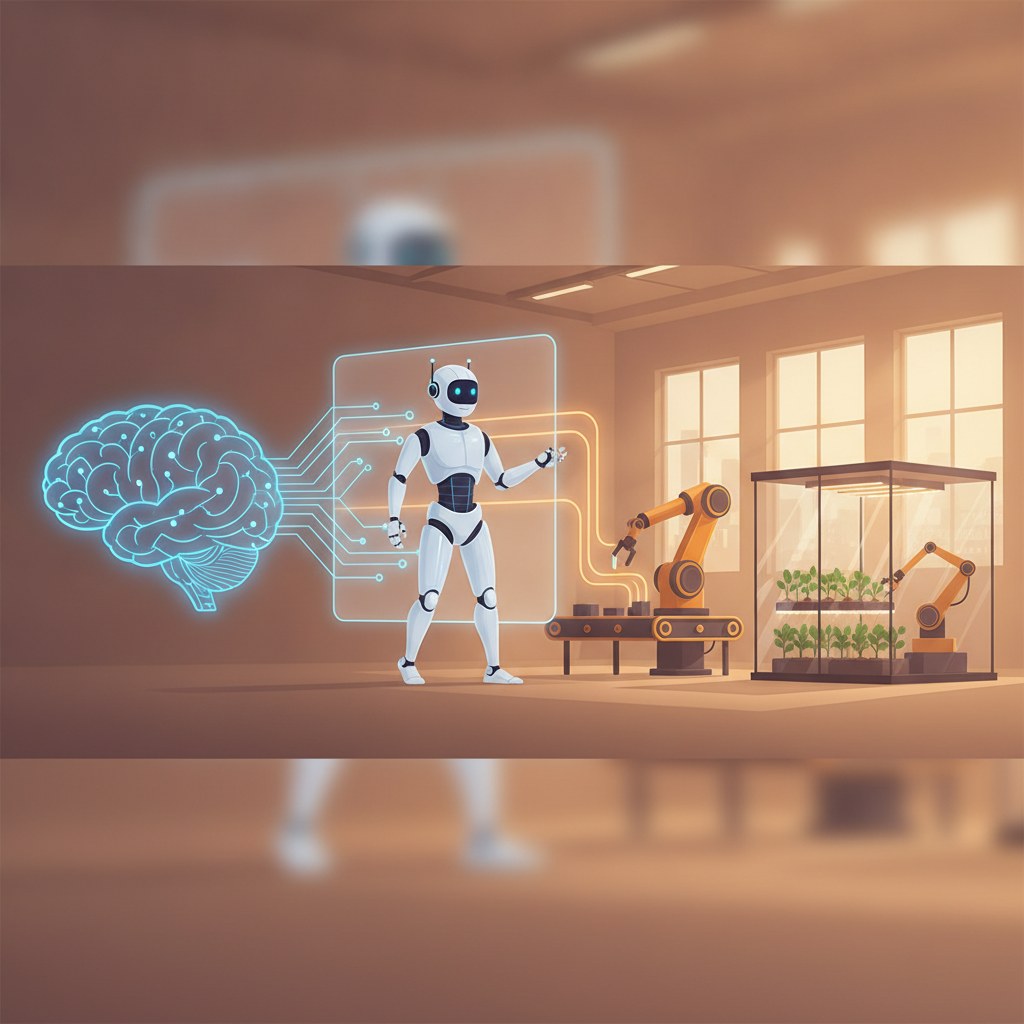
The problem: AI is stuck inside the screen
ChatGPT, Gemini, Claude — they're all smart, but they live in a box: text in, text out. Meanwhile, most of the world's wealth is created in the physical world — in factories, warehouses, fields, and construction sites. That's exactly where AI has barely set foot.
That gap is precisely why embodied intelligence is the hottest topic of 2026 — to the point that Chinese universities have just cut thousands of old majors to open an "embodied intelligence" program.
What is embodied intelligence?
It's AI placed inside a physical body — a robot, a robotic arm, a drone, a self-driving vehicle — to run one simple loop:
Sense (cameras, sensors) → Think (the AI model) → Act (motors, grippers) → Learn from the outcome.
The core difference from a chatbot: it doesn't learn by reading the internet, it learns by colliding with reality — gravity, friction, error, dropped objects. Intelligence doesn't live entirely in the "brain"; it lives in the interaction between brain and body.
Why is it exploding right now?
Three things just ripened at the same time:
- Foundation models for robots (VLA — Vision-Language-Action): a single model that sees an image, understands a language command, and outputs an action. Robots no longer have to be hard-coded motion by motion.
- Hardware got cheap: arms, sensors, and humanoid robots (Unitree, UBTECH...) have dropped sharply in price.
- Labor shortage + productivity pressure: aging populations and rising wages mean businesses are willing to pay for automation.
What does "bringing AI into the real economy" actually mean?
Not chatting, but doing valuable physical work:
- Factories: self-adjusting assembly robots, defect inspection via machine vision.
- Logistics: robots that pick, stack, and sort goods on their own, optimizing routes.
- Agriculture: drones that spray precisely, robots that kill weeds and pests with UV light instead of chemicals.
- Operations: demand forecasting, predictive maintenance before machines break.
How do you make money?
Five models, ordered from hardest to easiest to get into:
- Selling hardware: sell the robot outright — thin margins, a race to the bottom on price.
- Robot-as-a-Service (RaaS): rent it by the month/hour, recurring revenue — the most attractive option today because customers don't need to put up a lot of capital.
- Replacing labor: one robot running around the clock replaces 2–3 human shifts; the value you sell is the saved wages.
- Software & platforms: sell licenses, foundation models, subscriptions — the way in for software people who don't need to build hardware.
- Data: robots in operation generate real-world data → improve the model → resell a better service.
The real money today sits mainly in industry and logistics. Humanoid robots in the home are still at the deposit-and-expectation stage.
A path for developers and startups
You don't need to build robots to take part. The easiest layer to enter is software + data:
- Perception layer: machine vision for quality control (QC), counting and locating objects — sold per camera/month.
- Orchestration layer (agentic): an "orchestrator" coordinating multiple robots/machines, handling errors, scheduling — exactly the strength of people who build AI agents.
- Optimization layer: use operational data to cut power use, reduce defects, increase output.
A pragmatic formula: pick a narrow industry, one expensive and repetitive task, solve it with software, and sell it as a subscription — let someone else worry about the hardware.
Closing
For the past ten years, AI learned how to talk. For the next ten, it learns how to do. Whoever understands that the greatest value isn't in the robot itself, but in the control-software layer and the data it generates, will be standing in the right place when this wave lands.