To Have Taste, You Have to Eat
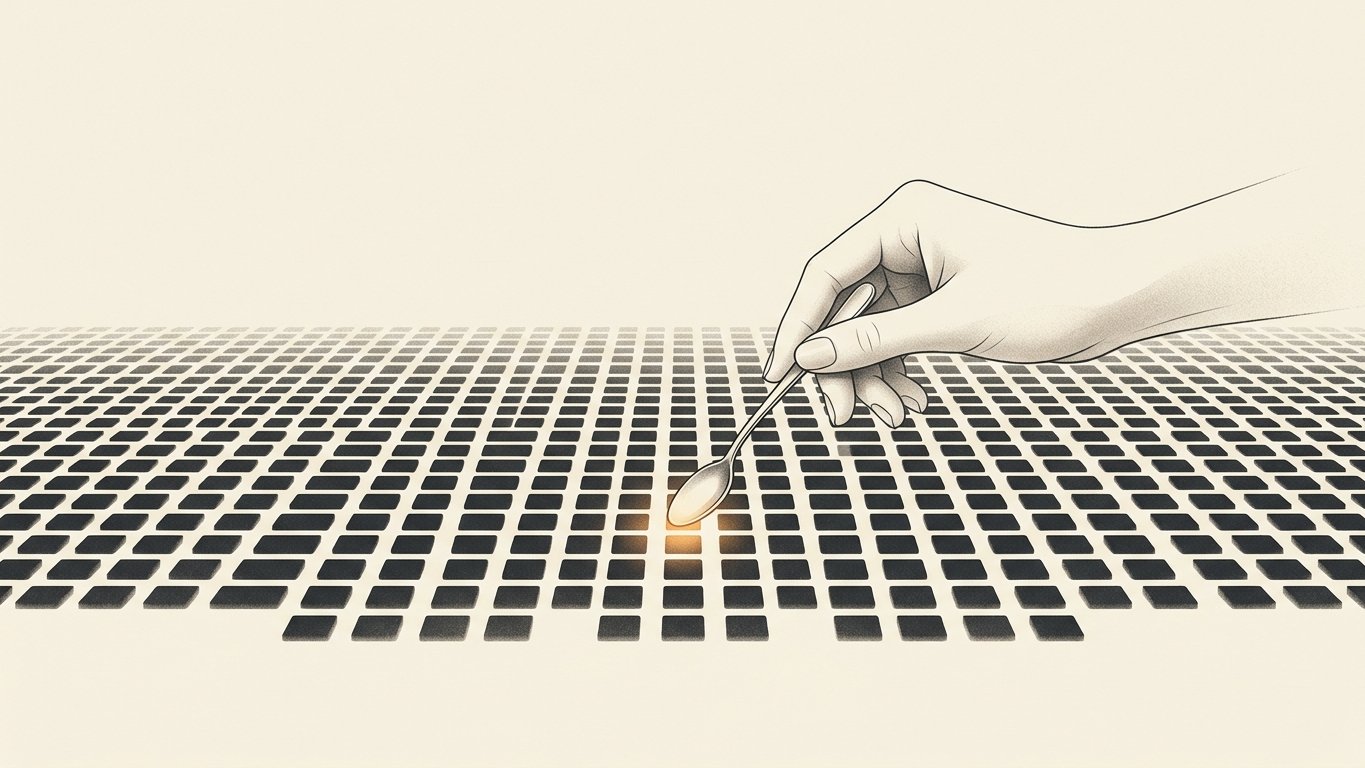
To have taste, you have to eat. It sounds simple, but it runs exactly backwards from how most people are playing this moment. Everyone is racing to produce more. Meanwhile the genuinely scarce thing is no longer the ability to produce — it's the palate that decides what's worth producing. Now that AI has let more and more people create things, the biggest differentiation, the biggest skill people are lacking, is taste itself.
Production went to zero
For most of history, the bottleneck was making the thing. Writing the code, cutting the film, drafting the copy, rendering the design. Skill meant the ability to execute, and execution was rare enough to be a moat all by itself.
AI collapsed that. The marginal cost of a competent-looking output — an essay, a landing page, a jingle, a function — is now roughly a prompt. When everyone can generate, generation stops being the differentiator. What's left is the part AI can't hand you: knowing which of the ten things it just made is the good one, and why.
That's taste. And taste is doing the heavy lifting now precisely because everything downstream of it got cheap.
Taste is a filter, not a spark
People romanticize taste as inspiration — some innate sense of beauty. It's more boring and more useful than that. Taste is a high-resolution filter: the ability to look at a wall of plausible options and reject the ones that are subtly wrong.
A designer with taste isn't the one who recognizes the good option. It's the one who has spent years learning which good-looking options are wrong for this problem, and says so out loud. Paul Graham put the same idea another way: when anyone can make anything, the differentiation becomes what you choose to make. Choosing is a filtering act. AI widened the funnel of what's possible; taste is what narrows it back down to what's right.
The uncomfortable part: a filter that fine can't be prompted into existence. You have to build it.
Which is why you have to eat
Here's the whole argument in one simple metaphor. You don't develop a palate by reading about food. You develop it by eating — a lot, across a huge range, paying attention while you do.
Taste is compressed experience. Every time you sit with something great and something mediocre and feel the gap between them, you're training a private model of "good." Do that a thousand times across a domain and you earn an instinct that fires in half a second: this is off. You often can't even articulate why at first — the why comes later. But the reaction is real, and it's earned, and it's yours.
This is the loop:
- Consume deliberately. Not passively. Read the best writing in your field and the worst, and notice the delta. Steep in the reference material until the average stops impressing you.
- Make a lot, and ship it. Reps against reality. Your taste outruns your ability at first — that gap is the discomfort that pulls you forward. The only way to close it is volume.
- Get real feedback. Taste calibrated in private drifts. Contact with an audience, a market, a harsh editor is what keeps it honest.
None of that is fast. That's the point — and, quietly, the good news.
The good news hiding in the bad news
If taste were just talent, you'd either have it or you wouldn't. But taste is accumulated exposure, which means it's the one advantage that compounds and that can't be copied at zero cost.
Anyone can copy your output tomorrow — AI will hand them a decent imitation before lunch. Nobody can copy the ten years of eating that let you look at that output and know instantly what to keep and what to kill. In a world where production is free, the years you spent building your palate aren't sunk cost. They're the moat.
So the move for the AI era isn't to out-produce the machines. It's to become the person who knows which of the machine's thousand outputs is the one worth shipping.
Which means: go eat.